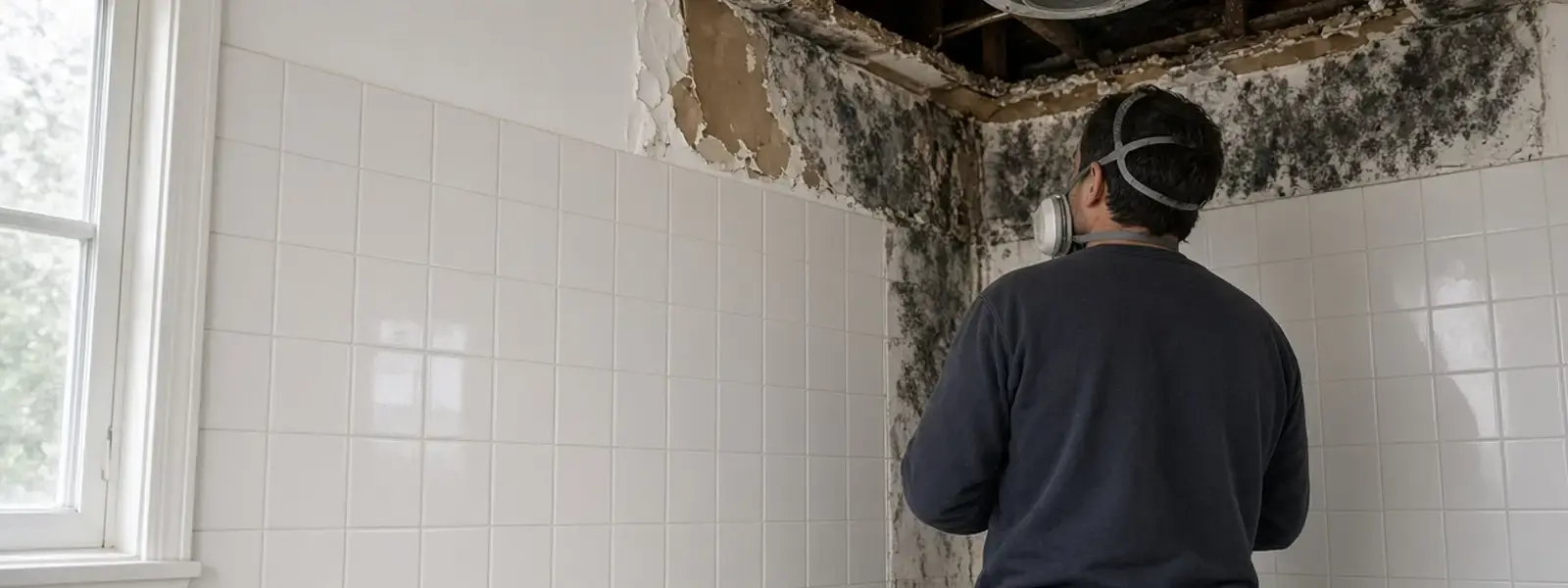
Bathroom mold removal in Langley is a fan, a grout line, and whatever is living behind the vanity. The ceiling spot is the advertisement. The colony is often in the wall the mirror is hiding.
A window that pours condensation every morning is a different problem from a soft wall beside the shower. One needs heat, a fan, and maybe a better window. The other needs the board opened. Langley Mold Remediation Services tells those apart with a meter before any caulk is sold to you.
Showers in 1990s and 2000s Langley houses fail at the corners, the valve, and the curb. By the time the paint bubbles on the hallway side, the cavity has been wet for a while.
What the visit includes
- Fan test: does it move air, and where does the duct end.
- Moisture readings on the ceiling, the shower wall, and the vanity wall.
- Removal of soft drywall and swollen MDF vanity backs.
- HEPA clean of the opened bay.
- Check of the valve and the obvious supply lines while the wall is open, with a plumber called if the valve is the leak.
- Grout and caulk notes. We are not a tile setter, and we will not pretend a bead of caulk is a waterproofing system.
- Drying before the wall is closed.
- A recommendation on fan size and duct route in plain language.
When Langley houses need this
Black spots on the ceiling only
If the board is dry and the spots wipe off a painted surface, this can be a clean plus a fan repair. If the board is soft, it is a removal.
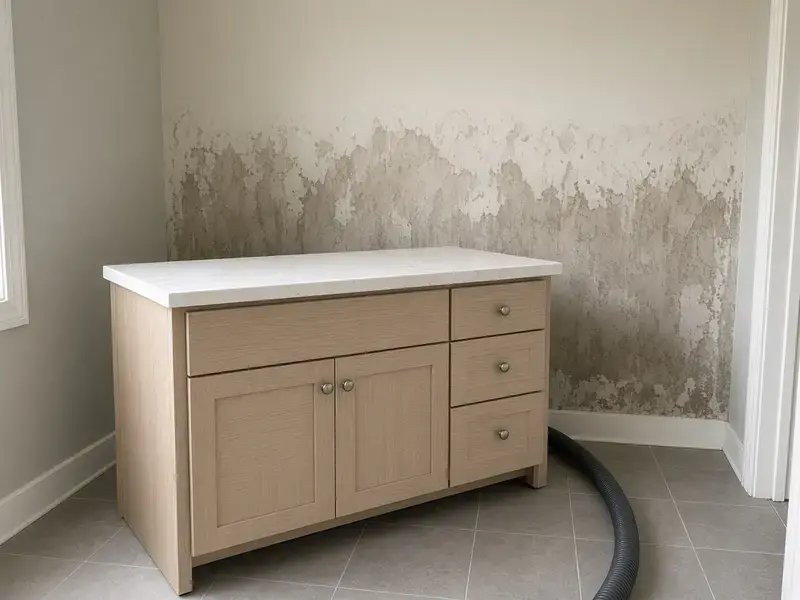
The vanity cabinet smells
Supply lines sweat or a slow drain wets the back panel. The MDF swells and grows. The panel comes out. The wall behind it gets metered.
Paint bubbling on the other side of the shower
That is cavity water. We open from the wet side. Recaulking the inside of the shower without opening the bubble is how people buy the same stain twice.
No window and a noisy fan nobody uses
The fan may be loud because it is clogged, or quiet because it is disconnected in the attic. We trace it. Surface mold on dry paint gets cleaned after the fan actually exhausts outdoors.
The sequence on site
1. Test the fan first
Tissue test, then the attic or the exterior hood. A fan that dumps into the attic is an attic mold job waiting upstairs and a bathroom job downstairs.
2. Meter the surfaces
Ceiling, shower wall, wall behind the toilet, vanity back. Soft and wet becomes a cut list. Dry and spotted becomes a clean list.
3. Open only the wet assembly
Vanity out if it is in the way. Drywall off to the dry line. We protect the tub and the floor so the demo does not wreck the fixtures you are keeping.
4. Look at the plumbing while it is open
If the valve or the trap is actively leaking, a plumber has to land before we close. We do not board over a drip.
5. Dry, then hand off the finish
New board, tile, and paint are rebuild. We leave the bay dry and photographed so the finisher is not guessing.
Why crews call this a bathroom mold removal job
Caulk is not the diagnosis
We will tell you if the caulk failed. We will not sell a recaulk as mold removal when the wall is soft.
Fans get traced
The grille in the ceiling is not proof of exhaust. We find the end of the duct.
Vanities are evidence
Swollen MDF gets replaced. A solid cabinet with a dry back can stay. We decide with the panel off.
Tile failures get named honestly
A failed shower pan is a tile and waterproofing repair. We remove the wet board outside the shower and tell you the pan is a different trade if that is what we see.
The building science under the stain
A bathroom fan is sized against the room, often discussed as cubic feet per minute, and it only counts if the duct is short, smooth enough, and terminated outdoors with a damper that opens. A long crushed flex run can cut the real airflow in half. During removal we note crushed duct because it explains the ceiling spots better than the brand of the grille.
Grout is porous. A shower that relies on grout alone, without a membrane behind the tile, will eventually wet the board. We see that in renovations from the 1990s. The mold on the hallway side is the end of that storey. Waterproofing the next shower is how the new board survives.
Condensation on a single-pane or cold aluminum window is common in older Langley bathrooms. That water runs onto the sill and into the drywall under the window. It looks like a small paint fail. The sill reading tells us whether the drywall below has joined in.
Exhaust into a soffit, which some installs do, can still pull moist air back into the attic through the vent. We look for that detail. 'There is a roof cap' and 'the duct is on the cap' are two different sentences.
Fraser Valley coverage
Bathroom Mold Removal provides coverage for Langley and extends through the Fraser Valley. The full town list is on the Areas page.
Questions on bathroom mold removal
Can I just bleach the bathroom ceiling?
If the paint is dry and the growth is on the surface, a careful clean and a working fan may be enough. If the gypsum is soft, bleach will not reach the back of the board.
Do you replace the fan?
We test it and trace the duct. If it needs a new unit or a new exterior termination, we say so. Electrical and roof penetrations may be a partner trade. We do not leave the old duct blowing at the sheathing.
Will you remove the tile?
We remove wet drywall outside the assembly and tell you if the shower itself needs a tile contractor. Smashing a sound shower to chase a vanity leak is not the plan.
Why does mold come back on the caulk?
Caulk stays wet and soapy. That is surface growth. It is annoying and it is not the same as a soft wall. We will say which one you have.
Can you work while we still use the other bathroom?
Yes. If this is the only bathroom, we plan the open-wall time with you so you are not surprised at night.
Call Langley Mold Remediation Services about the bathroom if the fan is loud and the ceiling is spotted, or if the wall outside the shower has a bubble. Those are the two usual Langley versions.