Commercial mold remediation in Langley covers shops, strata common property, storage lockers, and small offices. The building is usually still operating. The work has to stay in a box so customers and other units are not breathing the demo.
A parkade locker, a restaurant dry storage wall, and a strata mechanical room are three different containments. Langley Mold Remediation Services writes the scope to the room that is actually wet, then builds the barrier to match the traffic outside it.
Property managers want photos, hours, and a note they can send to the council. We produce that file. We do not need a public scene in the corridor to prove we were there.
What the visit includes
- After-hours or low-traffic scheduling when the business needs it.
- Containment that protects corridors, adjacent units, and HVAC returns.
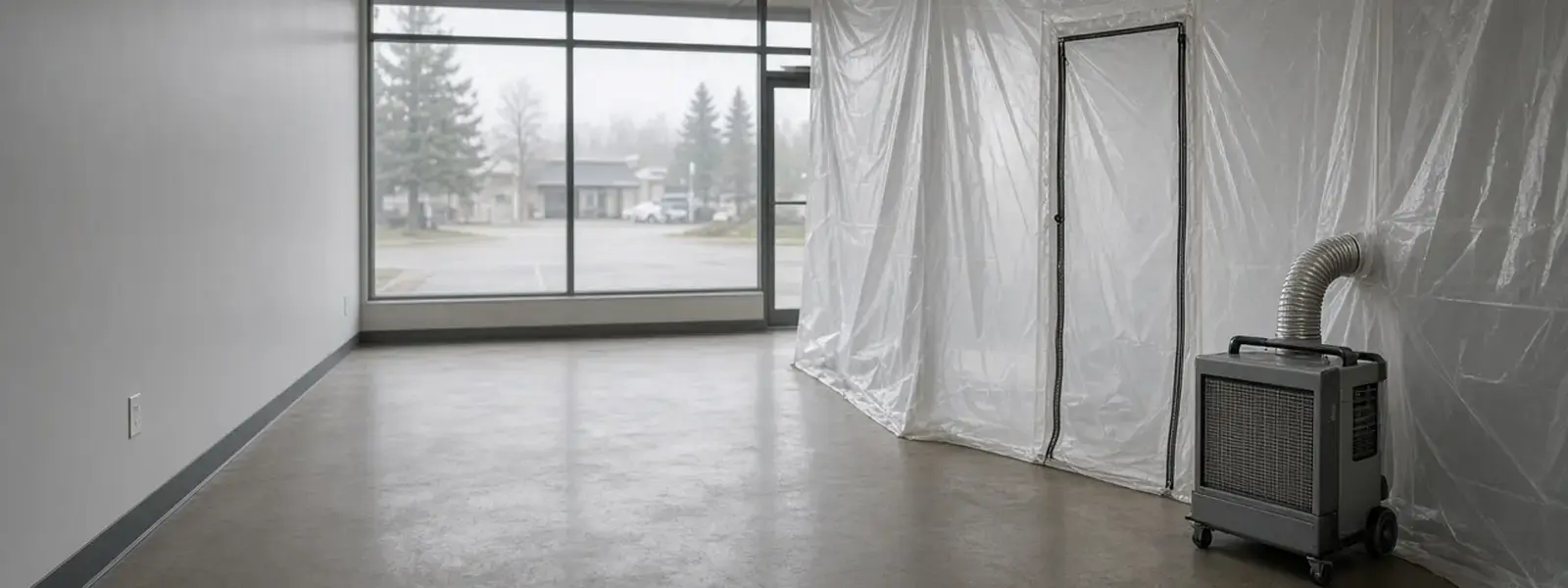
- Negative air sized for the suite, exhausted so it does not blow into a neighbour.
- Removal of colonized materials and HEPA cleaning.
- Drying with equipment placed so a morning opening is possible when the scope allows.
- Photos and a short written summary for the manager.
- Coordination notes if asbestos materials are in the work area.
- A clearance sample when the strata or the insurer asks for one.
When Langley houses need this
A retail unit after a roof leak
Inventory moved, ceiling open, work overnight, doors ready for customers. The containment lives in the back room if that is where the water went.
Strata locker or parkade cage
Concrete, stored goods, and a neighbour's cage inches away. We protect the adjacent locker and bag the waste out without dragging it through the lobby.
Mechanical room smell
A condensate pan or a leaking domestic line. The colony is on the wall behind the unit. Remediation includes isolating the room so the rooftop or the corridor is not the exhaust path.
A tenant complaint in a plaza
The landlord needs to know if it is one demising wall or a roof above several units. We map before we contain the wrong bay.
The sequence on site
1. Walk it with the person who has keys
Access, alarm, and what must be open in the morning. Commercial jobs fail on logistics as often as they fail on mold.
2. Map the wet assembly
Same meters as a house. A shop is still wood, gypsum, and water. The sketch decides the containment size.
3. Build a barrier the public cannot wander into
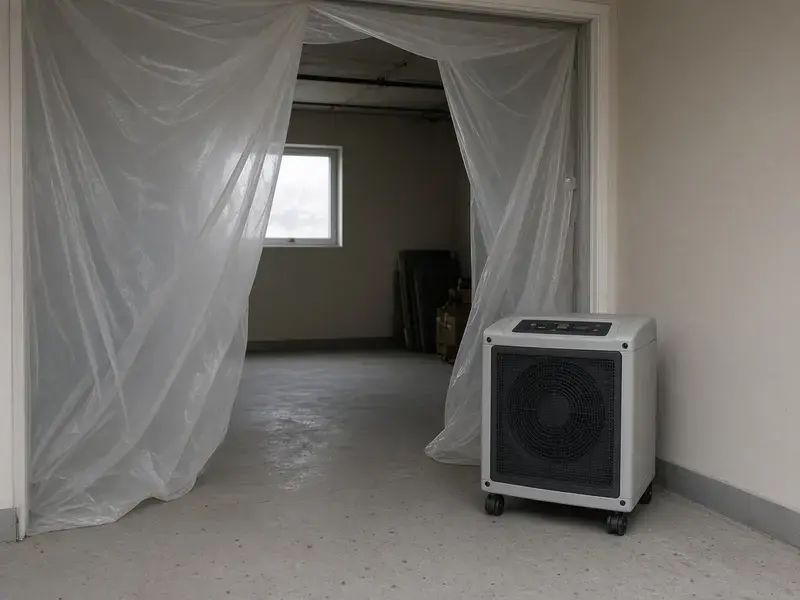
Poly, zipper, signs, and negative air. Returns covered. The exhaust path checked so we are not feeding the unit next door.
4. Remove, clean, dry
Colonized board out, HEPA on the framing, equipment running. If the business opens at eight, the barrier has to tolerate that, or the hours have to change. We pick one.
5. Leave the file
Photos, readings, and what is left for a contractor to rebuild. Councils and adjusters get the same storey.
Why crews call this a commercial mold remediation job
The corridor is a clean space
Waste does not sit in front of another business. The path out is planned.
Hours are part of the scope
We would rather work a night than surprise a cafe at breakfast. Say the constraint when you call.
Adjacent units get named
If the demising wall is wet on both sides, the scope says so. Pretending it is one side is how the second complaint starts.
Asbestos still stops the saw
Commercial ceilings and floors in older plazas are full of suspect materials. Testing is not skipped because the tenant is loud.
The building science under the stain
Negative air in a multi-unit building has to go somewhere. Exhausting into a shared plenum or a parkade return is a good way to move the problem. We look at the path. A window, a dedicated exhaust, or a HEPA recirculating setup each have limits, and we pick the one that does not load the neighbour.
Strata common property versus a strata lot is a governance question as much as a mold question. We describe the wet location. The council decides whose contractor is allowed to open it. Our notes are written so that argument has photos instead of rumours.
Food businesses add a health-inspection concern on top of the building. We contain so dust is not in the prep area, and we will say if the health authority expectation is outside our work. Drying a wall is not a food-safety certificate.
Commercial carpet tile and metal stud walls change the demo, not the science. Metal studs do not feed mold. The drywall paper and the insulation do. We still meter, still remove the paper that grew, and still dry the cavity. The studs get wiped, not dramatized.
Fraser Valley coverage
Commercial Mold Remediation provides coverage for Langley and extends through the Fraser Valley. The full town list is on the Areas page.
Questions on commercial mold remediation
Can you work after hours?
Yes. Say when the unit has to be customer-ready. We will tell you if the drying equipment can stay quietly or if the barrier needs another night.
Do you remediate parkade storage lockers?
Yes. Concrete, cages, and stored paper are a regular Langley call. Neighbouring cages get protected.
Will the rest of the plaza smell the work?
The containment and the exhaust path are there to prevent that. If the HVAC is shared and was already moving air, we say so and isolate returns before demo.
Can you talk to our insurer and our strata?
We can provide the photos, readings, and a description of the work. Coverage decisions and strata minutes are theirs.
Is commercial work different from a house?
The fungus is not different. The occupancy, the shared air, and the paperwork are. The protocol is tighter about neighbours.
Managers can call Langley Mold Remediation Services with the unit number and whether the business is still open. We will tell you if it is a night job before we book it.